By Carl Meyer (Associate at Hurter Spies Incorporated)
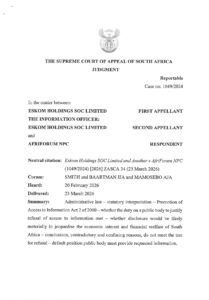
On 23 March 2026, the Supreme Court of Appeal handed down judgment in Eskom Holdings SOC Limited and Another v AfriForum NPC [2026] ZASCA 34, dismissing Eskom’s appeal with costs, including the costs of two counsel, and ordering it to grant AfriForum access to its active coal and diesel contracts. Hurter Spies Incorporated acted as attorneys of record for AfriForum, having advised on and prosecuted the matter from the original PAIA request in 2022 through the high-court application and the appeal. The judgment is reportable and adds materially to the body of jurisprudence under the Promotion of Access to Information Act 2 of 2000 (“PAIA”).
This article sets out the facts, the issues, the SCA’s reasoning, and the practical implications for public bodies, requesters, and practitioners advising clients in this area.
The facts
The litigation arose against the backdrop of the 2022 loadshedding crisis. On 11 June 2022, AfriForum submitted a PAIA request to Eskom for access to its active coal and diesel contracts, related transport contracts, and contracts for the supply of electricity to neighbouring countries.
Eskom partially complied, releasing lists of active contracts and contract types but refusing access to the underlying agreements. It relied on section 42(3)(b) and (c) of PAIA (commercial and financial harm to the State or a public body; disadvantage in contractual negotiations) and, in the alternative, section 36(1)(b) and (c) (mandatory protection of third-party commercial information). Its electricity-supply contracts with neighbouring countries were later made available, removing that strand from the appeal.
On 28 September 2022, an internal appeal was lodged in which reliance was also placed on section 46 (mandatory disclosure in the public interest). Eskom’s failure to decide the internal appeal within the prescribed period operated, under section 77(7), as a deemed dismissal, and the matter proceeded to the Gauteng Division of the High Court, Pretoria.
Windell J ruled in AfriForum’s favour, finding Eskom’s grounds for refusal “insufficient and without any merit”. Leave to appeal was granted on a narrow basis. The High Court accepted that it had applied a more stringent test than the one established in Transnet Ltd and Another v SA Metal Machinery Company (Pty) Ltd 2006 (6) SA 285 (SCA).
The issues
The SCA, per Baartman JA (Smith JA and Mamosebo AJA concurring), identified three issues:
The correct test under section 42(3)(b) of PAIA; whether Eskom’s refusal was justified applying that test; and whether section 46 independently justified the High Court’s order.
The Transnet test – reaffirmed and extended
The court reaffirmed Transnet. The distinction between “would be likely to cause harm” in subsection (b) and “could reasonably be expected” in subsection (c) is not a matter of the degree of probability but of the degree of expectation. Both involve a probable result, objectively considered. Subsection (b) covers what “is indeed expected”, which necessarily includes that which “would reasonably be expected”. Subsection (c) captures consequences that “could be expected as probable” if reasonable grounds exist for the expectation.
Critically, although Transnet was decided in relation to section 36(1), the SCA confirmed that the same test applies to section 42(3), because the two sections “are similar in context and text”. This extension is significant. Practitioners and information officers now have one unified framework for assessing the commercial-harm grounds in both the third-party protection (section 36) and public body protection (section 42) regimes of PAIA.
Why Eskom’s reasons failed
Eskom’s reasons, first stated on 12 September 2022 and amplified on 18 November 2022, were, in essence, that it spends approximately R70 billion annually on coal procurement and transport; that disclosure of contract prices would enable existing and prospective suppliers to negotiate upwards; that lower-priced suppliers would adjust their prices upwards too; that bidders would “position themselves” to supply at inflated terms; and that collusion among suppliers could “reasonably be expected”, with the Russia-Ukraine war creating fertile conditions for opportunism.
The SCA found this reasoning unpersuasive and, critically, internally contradictory. The court accepted submissions made on behalf of AfriForum that:
- Coal prices are a matter of public knowledge: the World Bank routinely publishes commodity data;
- Eskom procures coal through open competitive tender processes, in which Bid Evaluation Committees are obliged to negotiate commercially sensible terms;
- Awarded contracts frequently surface in review litigation and so enter the public domain regardless;
- Once a contract is awarded, the confidentiality clause “offers no further protection from disclosure as regards the tender price”; and
- Bidders have historically known prevailing coal prices before bidding without collusion materialising, making the apprehension of future collusion unreasonable.
The diesel arguments fared no better. AfriForum annexed an excerpt from Globalpetrolprices.com showing the prevailing South African diesel price of R22.21 per litre – a benchmark routinely used in supply agreements. There could be no commercial sensitivity in disclosing the price at which Eskom purchased diesel. On transport costs, which Eskom claimed were embedded in the diesel price, public knowledge of the average diesel price would in fact enable a market-related assessment.
On the section 36 third-party-harm ground, the court held that Eskom had advanced only general allegations. PAIA itself contemplates that unsuccessful bidders may access an awarded contract, so pricing terms are commonly disclosed to third parties as a matter of course. Eskom never identified what was, in fact, commercially sensitive about these contracts.
Section 46 – Not reached, but clarified
Although AfriForum had also relied on section 46 (mandatory disclosure in the public interest), the SCA found it unnecessary to decide that point. Because Eskom had not met the refusal standard under sections 36(2) and 42(3), the default in section 11 – that a compliant requester must be granted access – applied without more.
Baartman JA added an important obiter dictum: section 46 requires evidence “specific to the contracts sought to be accessed”, and “general allegations of corruption at a public entity are not sufficient”. Requesters who wish to deploy the public-interest override will need to do contract-specific work, i.e connecting the documents sought to evidence of substantial contraventions of the law or imminent risks.
Practical implications
Several practical implications flow from the judgment, in our view:
First, the constitutional default of disclosure has been emphatically restated. Section 32(1) of the Constitution entrenches the right of access to information held by the State, and PAIA gives effect to that right. The SCA’s framing – that disclosure is “the default position” – squarely places the justificatory burden on the public body.
Second, information officers must engage with the factual matrix in their refusal letters. Boilerplate invocations of commercial sensitivity, negotiation prejudice or collusion risk will not survive scrutiny if the underlying information is already in the public domain or if the public body’s reasoning is internally inconsistent. Public bodies refusing access should expect their reasons to be tested against the evidence. Contradictory reasons will be fatal.
Third, the limits of confidentiality clauses in public procurement have been sharpened. Suppliers contracting with the State should not assume that confidentiality undertakings will shield post-award pricing from PAIA disclosure.
Fourth, requesters relying on section 46 must marshal contract-specific evidence. General reliance on the Zondo Commission’s findings, for example, or independent auditor’s reports will not, on its own, discharge the burden.
Hurter Spies Incorporated – Public-Law and PAIA Practice
This matter forms part of Hurter Spies Inc.’s ongoing practice in constitutional- and administrative law litigation, and particularly in PAIA litigation directed at compelling state-owned entities and organs of state to account to the public for the use of public resources.
Are you aware of any information that you think should be public knowledge but isn’t, or do you intend on bringing a PAIA application but require assistance with the compilation thereof. We would gladly be of assistance in this regard.
For further information on the firm’s public-law practice, or to discuss a PAIA matter, please contact our offices on 012 941 9239.